
Canadian bank notes and coins
The citizenship test can ask whose portrait is on a bank note or which animal is on a coin. Here is what is on each note and coin in circulation today, and why it was chosen. Bank notes are issued by the Bank of Canada; coins are made by the Royal Canadian Mint.
Quick answers
| Note | Front (portrait) | Back (theme) |
|---|---|---|
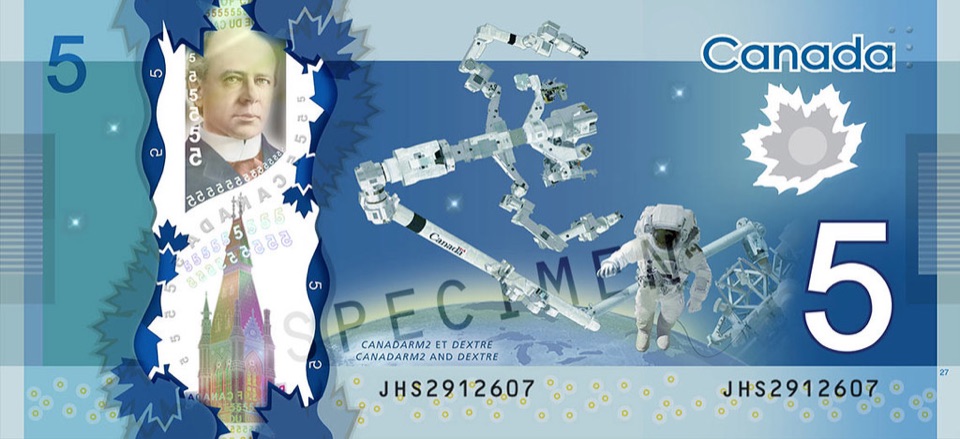
| $5 | Sir Wilfrid Laurier | Canadarm2 and Dextre |
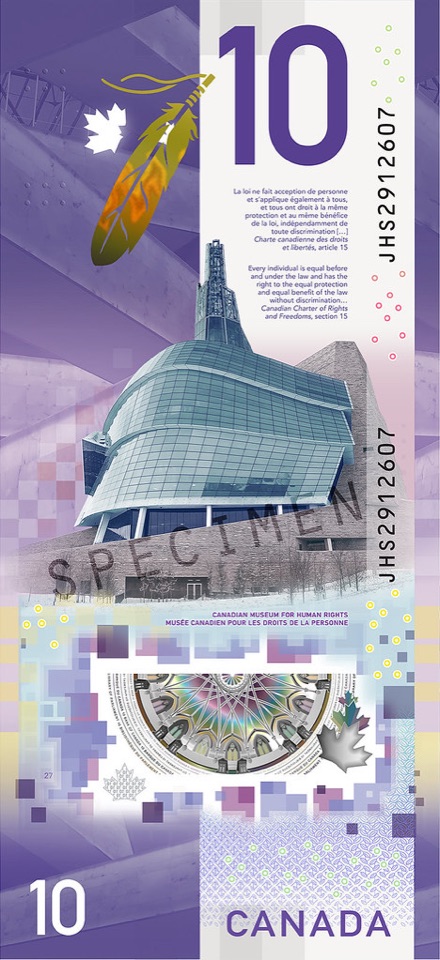
| $10 | Viola Desmond | Canadian Museum for Human Rights |
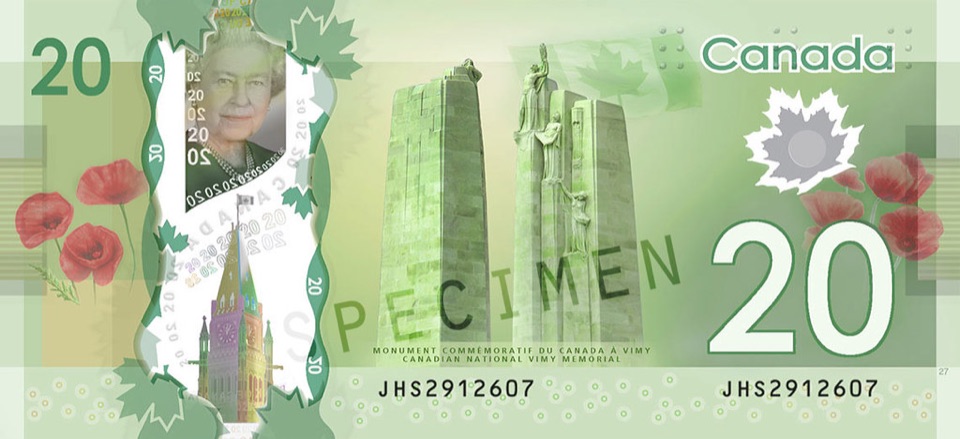
| $20 | Queen Elizabeth II | Canadian National Vimy Memorial |
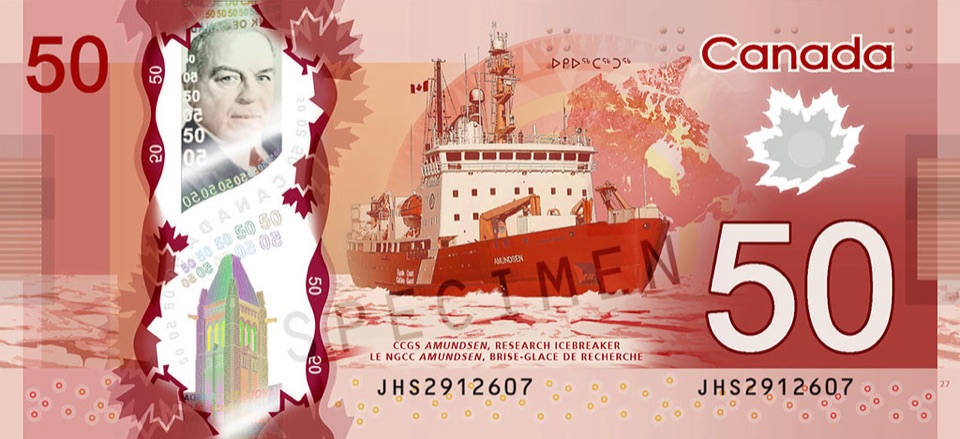
| $50 | William Lyon Mackenzie King | CCGS Amundsen, research icebreaker |
| $100 | Sir Robert Borden | Medical innovation |
| Coin | Shows |
|---|---|
| 5¢ nickel | A beaver on a rock |
| 10¢ dime | The schooner Bluenose |
| 25¢ quarter | The head of a caribou |
| $1 loonie | A common loon |
| $2 toonie | A polar bear on an ice floe |
| 1¢ penny (retired) | Two maple leaves on a twig |
| 50¢ fifty-cent piece | The Arms of Canada (coat of arms) |
Bank notes
All current notes are made of polymer (plastic), not paper. Every one has a clear window with a metallic portrait and an image of a Parliament building as security features.
$5 note · blue · issued November 2013
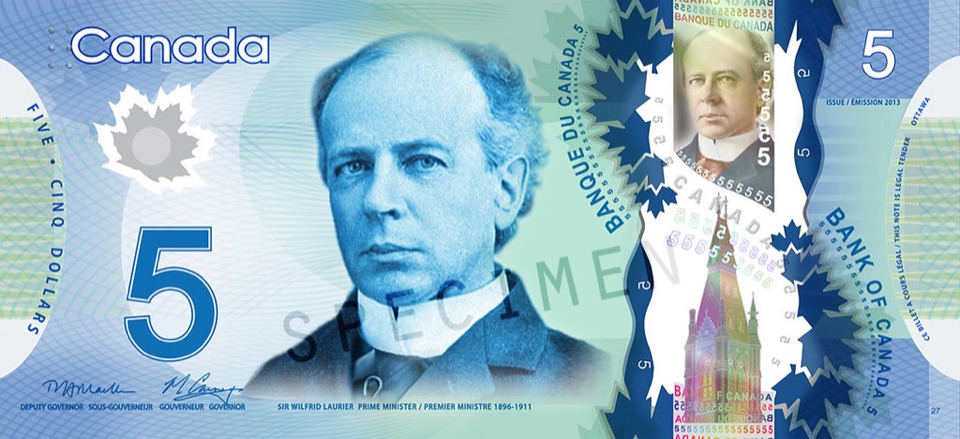
Front: Sir Wilfrid Laurier, Prime Minister from 1896 to 1911 and the first French Canadian to hold the office after Confederation. The metallic building in the clear window is the West Block of Parliament.
Back: Canadarm2 and Dextre, the Canadian-built robotic arm and "hand" that helped assemble the International Space Station, with an astronaut on a spacewalk above the Earth.
Why: Laurier promoted settlement of the West and national unity between English and French Canadians. The space robots celebrate Canada's contribution to the international space program.
$10 note · purple · issued November 2018
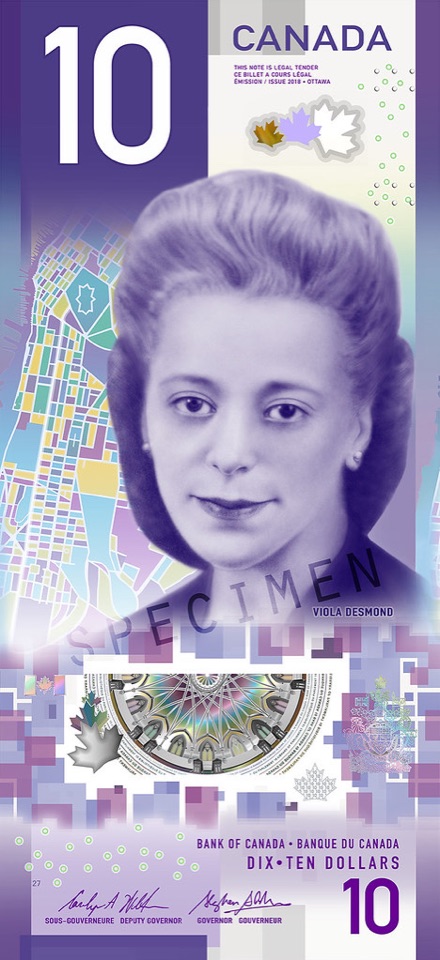
Front: Viola Desmond, a Black businesswoman from Halifax, beside a colourful historic map of Halifax's North End (the waterfront, the Citadel and Gottingen Street), where she lived and ran her business. The window shows the vaulted dome ceiling of the Library of Parliament.
Back: The Canadian Museum for Human Rights in Winnipeg, an eagle feather (a symbol of truth, power and freedom), and the equality clause of the Canadian Charter of Rights and Freedoms (section 15): every individual is equal before and under the law.
Why: In 1946 Desmond refused to leave the whites-only section of a movie theatre in New Glasgow, Nova Scotia. She was jailed, convicted and fined; her stand became a landmark of Canada's civil rights movement, and she was pardoned after her death in 2010. This was Canada's first vertical bank note, and Desmond the first Canadian woman shown on her own on a regularly circulating Bank of Canada note. The whole note is about rights and social justice.
$20 note · green · issued November 2012
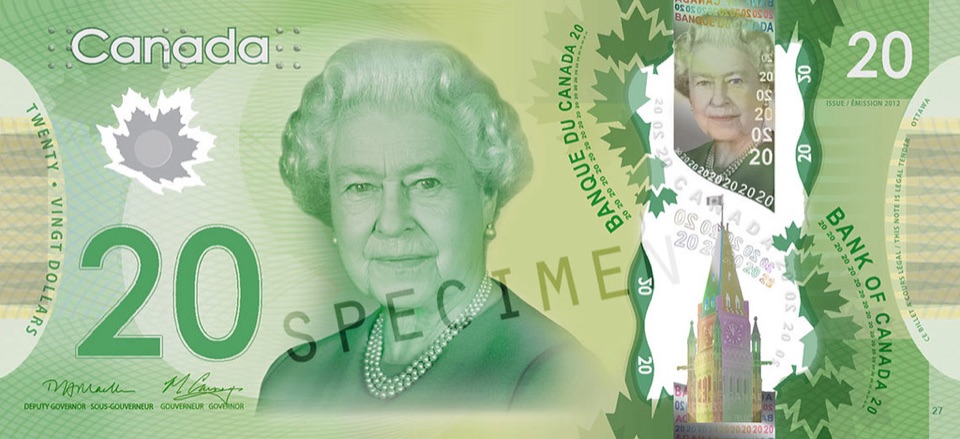
Front: Queen Elizabeth II, Canada's sovereign from 1952 to 2022. The window shows the Peace Tower of Parliament's Centre Block.
Back: The Canadian National Vimy Memorial in France, built on the site of the 1917 Battle of Vimy Ridge, with red poppies.
Why: Canada's head of state has traditionally appeared on the $20. The Vimy memorial honours Canadians' service and sacrifice in the First World War; the victory at Vimy Ridge is remembered as a moment of Canada's coming of age as a nation. The $20 is the note Canadians use most, since it is the one ATMs dispense.
$50 note · red · issued March 2012
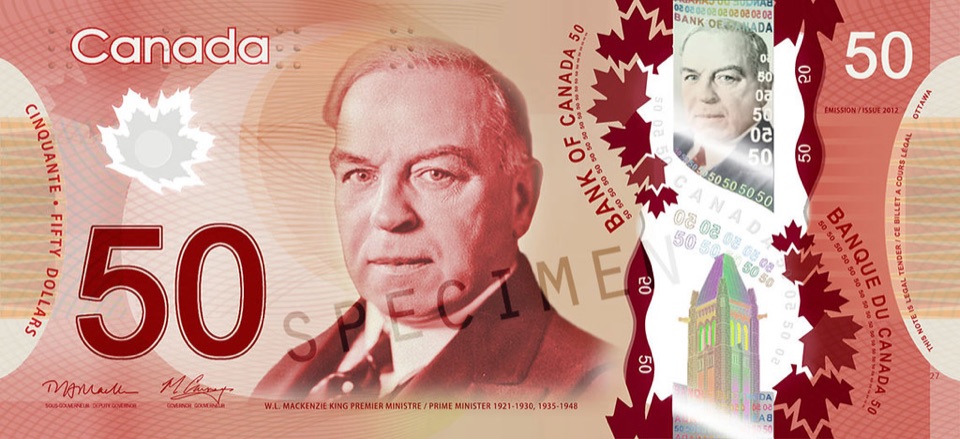
Front: William Lyon Mackenzie King, Prime Minister from 1921 to 1930 and 1935 to 1948 — Canada's longest-serving prime minister. The window shows Parliament's Centre Block.
Back: The Canadian Coast Guard research icebreaker CCGS Amundsen in Arctic waters, with a map of northern Canada and the word "Arctic" in Inuktitut.
Why: King led Canada through most of the Second World War. The icebreaker stands for Canada's North: Canada has the world's longest Arctic coastline, and icebreakers keep northern passages open, support remote communities and carry Arctic research.
$100 note · brown · issued November 2011
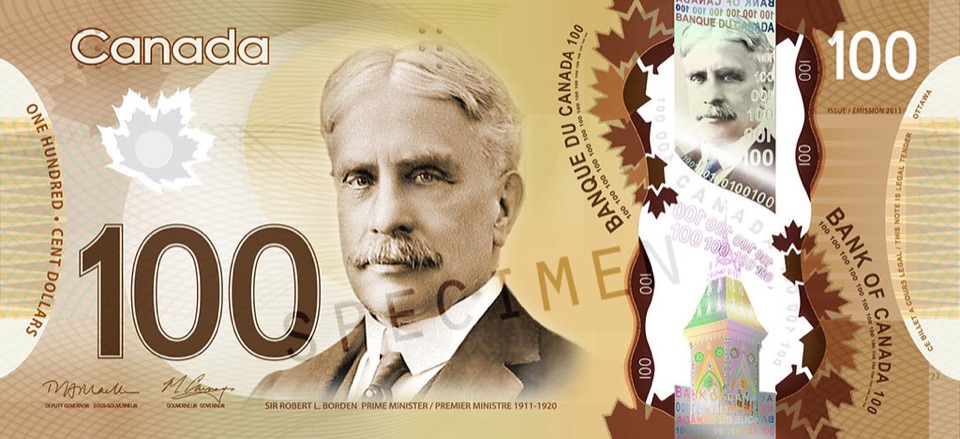
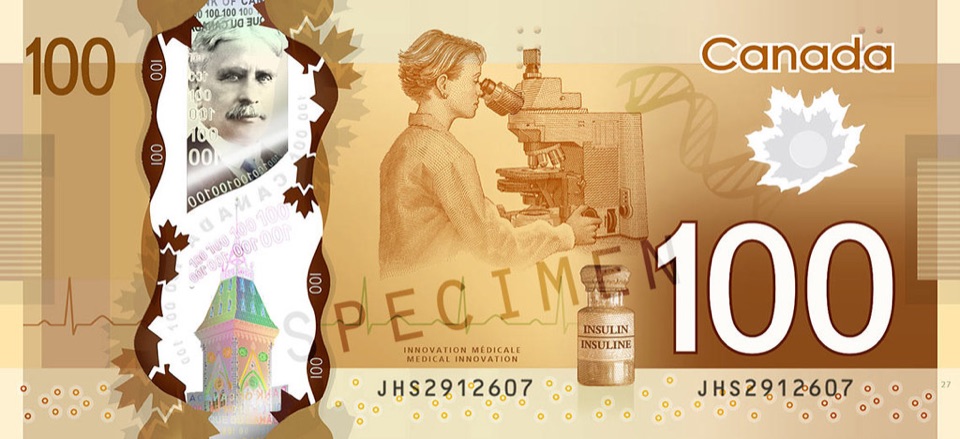
Front: Sir Robert Borden, Prime Minister from 1911 to 1920. The window shows the East Block of Parliament.
Back: A researcher at a microscope, a vial of insulin, a DNA strand and an electrocardiogram (ECG) trace.
Why: Borden led Canada through the First World War, won Canada its own signature on the peace treaty, and his government gave women the federal vote (1917–18). The back celebrates Canadian medical breakthroughs: insulin to treat diabetes (Banting and Best, 1921), DNA and genetic research, and the invention of the pacemaker.
You may still see the older polymer $10 note with Sir John A. Macdonald, Canada's first Prime Minister, on the front and the passenger train The Canadian on the back. It is still legal tender. The 2012 edition of Discover Canada shows that older note.
New notes coming
- $20 with King Charles III. Unveiled on 3 September 2026 and expected in circulation in early 2027. Like the $10, it is vertical, and it keeps the tradition of showing the sovereign on the $20. Its design includes floral emblems of all 13 provinces and territories and the Vimy Memorial.
- $5 with Terry Fox. The Bank of Canada has chosen Terry Fox, who ran his Marathon of Hope across Canada in 1980 to raise money for cancer research, as the next $5 portrait. No release date yet; it will come after the new $20.
Until the new notes arrive, test answers follow the notes above: Queen Elizabeth II on the $20 and Laurier on the $5.
Coins
The front of every coin shows the reigning sovereign: Queen Elizabeth II on most coins in your pocket, and King Charles III on coins minted since late 2023. The back shows a Canadian symbol.
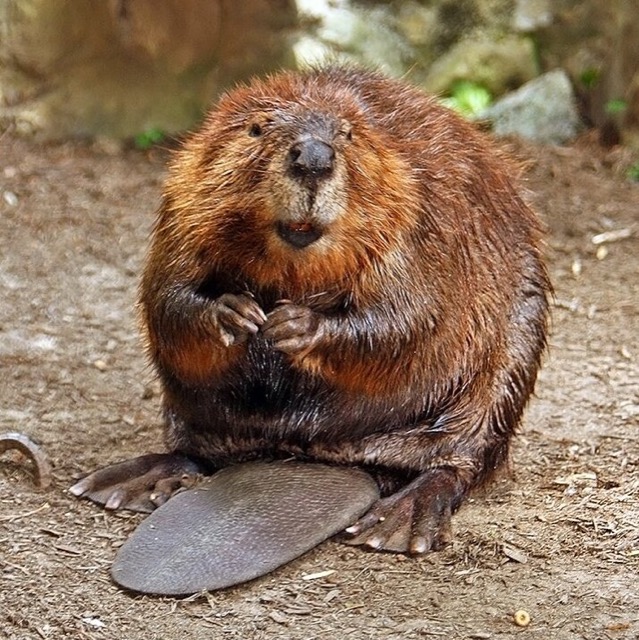
5¢ · Nickel
Shows: A beaver on a rock
The beaver drove the fur trade that shaped early Canada, was the emblem of the Hudson's Bay Company, and is an official symbol of Canada. It has been on the nickel since 1937.
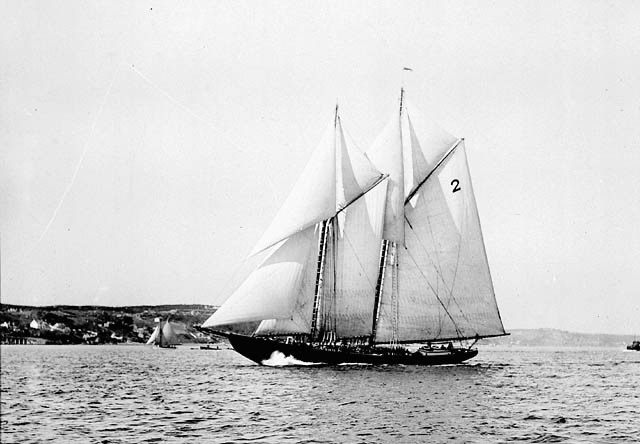
10¢ · Dime
Shows: The schooner Bluenose
Bluenose was a Nova Scotia fishing and racing schooner launched in Lunenburg in 1921 and never beaten in the International Fishermen's Trophy races. It stands for Canada's seafaring and shipbuilding history. On the dime since 1937.
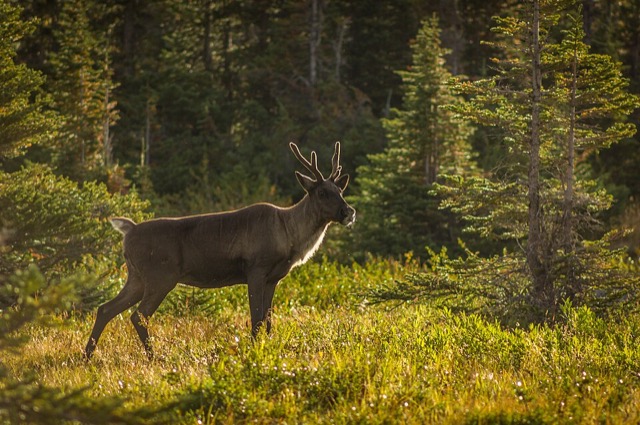
25¢ · Quarter
Shows: The head of a caribou
The caribou represents the wilderness of the North and has long been vital to Inuit and First Nations peoples for food and clothing. On the quarter since 1937.
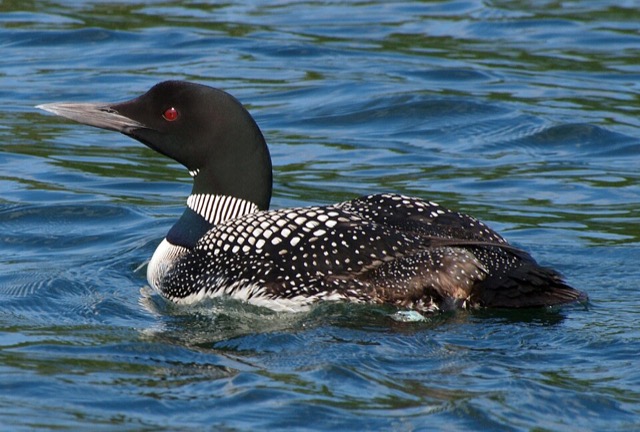
$1 · Loonie
Shows: A common loon
The loon, a diving bird whose call is heard across Canada's lakes, gave the coin its nickname. The $1 coin replaced the $1 note in 1987.
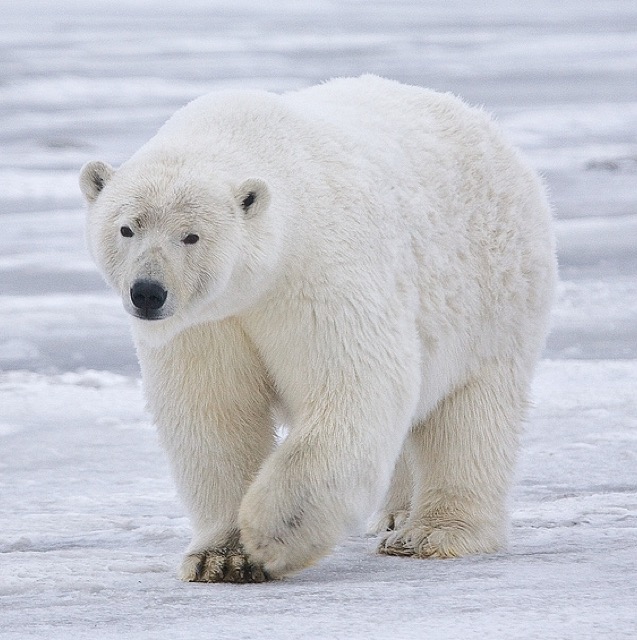
$2 · Toonie
Shows: A polar bear on an ice floe
The polar bear represents Canada's Arctic. The two-coloured $2 coin replaced the $2 note in 1996; its name is a play on "loonie".
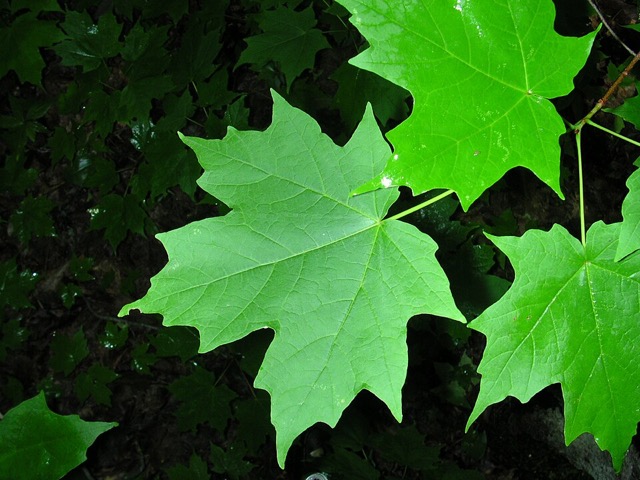
1¢ · Penny (retired)
Shows: Two maple leaves on a twig
The maple leaf is the best-known symbol of Canada. Canada stopped distributing pennies in 2013; they are still legal tender, but cash totals are now rounded to the nearest 5 cents.
50¢ · Fifty-cent piece
Shows: The Arms of Canada (coat of arms)
Shows the Arms of Canada, with the motto A mari usque ad mare ("from sea to sea"). It is still made but rarely seen in everyday change.
Photos show the subject of each coin's design, not the coin itself: coin designs are the property of the Royal Canadian Mint. This site is not affiliated with or endorsed by the Royal Canadian Mint.
Ready to check what you know?
Image credits
Bank note images: Source: Bank of Canada. Shown as published in the Bank's image gallery; this site is not affiliated with or endorsed by the Bank of Canada.
- Beaver: Steve from Washington, DC, CC BY-SA 2.0, via Wikimedia Commons (resized).
- Bluenose, 1921: Wallace R. MacAskill, public domain, via Wikimedia Commons (resized).
- Woodland caribou: ThartmannWiki, CC BY-SA 4.0, via Wikimedia Commons (resized).
- Common loon: John Picken, CC BY 2.0, via Wikimedia Commons (resized).
- Polar bear: Alan Wilson, CC BY-SA 3.0, via Wikimedia Commons (resized).
- Sugar maple leaves: Superior National Forest, CC BY 2.0, via Wikimedia Commons (resized).